Why it matters now
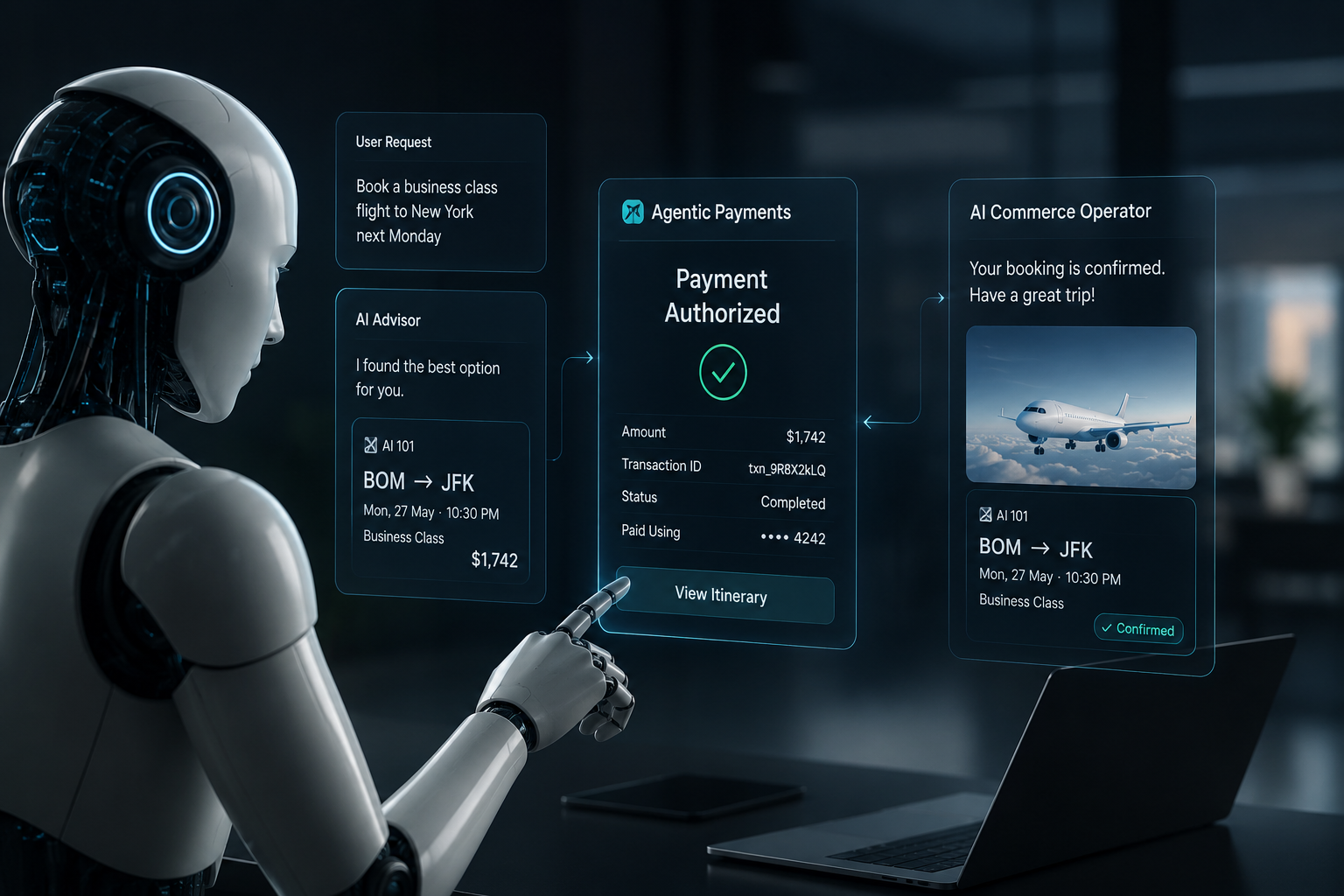
This matters because payment capability changes the enterprise architecture conversation. Once an agent can place an order, book a service, or complete a procurement step, AI is no longer a content layer. It becomes an operational actor with financial consequences. That pushes identity, policy, treasury, merchant controls, and auditability into the center of product design. For retailers and B2B sellers, it also raises a strategic question: should the brand optimize for human browsing, agent-mediated buying, or both?
How it works in practice
The practical design pattern is delegated execution with hard guardrails. Enterprises define spending limits, merchant-category controls, approval thresholds, and tokenized payment credentials. The agent can then complete a bounded task such as reordering office supplies, booking approved travel, or finalizing a low-risk procurement event, while higher-risk purchases escalate to a human. This architecture resembles corporate card control frameworks more than consumer chatbot design. The operating question is who authorizes what, under which policies, with what traceability.
Real-world examples
Visa and Mastercard infrastructure moves
Both networks have been exploring ways to let software agents act in payment flows without exposing raw credentials, which creates a more practical path for enterprise adoption.
Procurement automation parallels
The closest enterprise precedent is policy-driven procurement platforms where software can route, approve, and document purchases under defined rules.
Replenishment and low-risk buying
A likely early pattern is controlled replenishment, such as office supplies, standardized services, or approved vendor reorders where policies are already well understood.
Commerce experience redesign
Sellers that expose structured offers and approval-aware APIs will be better positioned when agents start comparing and completing purchases on behalf of buyers.
Pitfalls to avoid
- Treating payments as a UX experiment Agentic payments are a financial control problem first. If policy, approvals, and liability are vague, the experience layer is irrelevant.
- Blurring recommendation and authority An agent that can suggest options should not automatically inherit the right to finalize a purchase without explicit policy boundaries.
- Fragmented rule enforcement If the model, wallet, ERP, and identity stack all enforce different logic, the organization creates reconciliation risk and control gaps.
- Ignoring merchant readiness If pricing, fulfillment, and contract terms are not machine-readable, agentic buying creates disputes faster than it creates efficiency.
Frequently asked questions
Conclusion
Agentic payments turn AI from an advisory surface into a governed commercial actor. The advantage will go to enterprises that treat transaction authority as a control-system design problem, not a convenience feature.